Rajan Parrikar Music Archive

Western Pop Music Is Trash


A fact, not an opinion.

by Rajan P. Parrikar

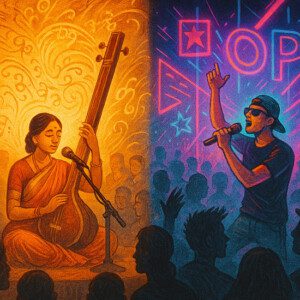
Indian Music, Western Pop

This is not a tirade against “the West.” I have lived in it for decades, benefited from its institutions, and learned from some of its finest minds. But a culture that has long presumed the right to critique and grade the rest of the world must be willing to accept the gaze in return.

Western popular music is not globally dominant because it is good, but because the West is powerful.


The Illusion of Ubiquity

The global spread of Western popular music has little to do with merit. It is the byproduct of geopolitical muscle, media control, and the self-regard of cultural power. Its reach is wide, but its depth is negligible, and when the layers of hype and nostalgia are stripped away, what remains is a noisy, repetitive, melodically barren heap dressed up as art.

This is not an anthropological exercise. It is a value judgement. Appeals to relativism, that all music is equal within its cultural frame, are a convenient evasion. Western pop is musically impoverished: it lacks complexity, subtlety, and emotional range. One may cloak it in theory or prop it up with market statistics, but the substance does not change. It is, for the most part, manufactured sonic pulp.

Noise Without Soul

The problem begins at the level of sound itself. The standard Western drum kit is built around noise, not tone. It supplies punctuation, but contributes nothing to melody. Contrast this with the Indian tabla, whose central loading allows for a rich range of tonal modulation, expressive nuance, and even melodic interplay. Or with many African traditions, where rhythm is not mere background pulse but speech, structure, and soul. The difference here is not cultural, but musical.

Layer the drum kit with three or four recycled chords, a predictable beat, and lyrics aimed at hormonal adolescents, and you have the basic anatomy of Western pop. 

It is music built to agitate the body, not elevate the mind.

This is no small distinction. Indian music rests on an entirely different aesthetic foundation, one that aims at inward refinement rather than outward stimulation. Rhythm is not absent, far from it, but its role is integrated and deliberate. Cycles of 5, 7, 10, 14, 16 and more, including additive and fractional patterns, are routine. The interplay of melody and rhythm is not merely complex; it sharpens perception and engages the intelligence.

By comparison, Western genres reveal their limits quickly. Techno reduces the ear to a receptacle for industrial waste; bar music dissolves into background wallpaper; hip-hop, once a vital voice of dissent, now circles endlessly around narcissism and violence. These are not the signs of a healthy musical culture. They are symptoms of degeneracy.

The limitations of Western pop are evident not only in its structure, but in the stature of its celebrated figures. Dylan, Lennon, Presley: mediocrities inflated by cultural monopoly. Dylan, endlessly lauded yet essentially monotone; Lennon, narrow in melodic range; Presley, all affected swagger. Is this the summit? Sinatra seems dignified only by standing among lesser men. There have been rare figures of genuine merit, Ray Charles, Louis Armstrong, whose phrasing, tonal invention, and musical authority reshaped what popular singing could be. But they are exceptions. Meteors across an otherwise dim sky.

The failure runs deeper than presentation. Western pop lacks melodic imagination. Its tunes are not vessels of feeling but crude scaffolds for rhythm or attitude, and the relationship between words and melody is rarely organic. Verses are bent to fit the beat, or dissolved into slurry delivery. What should be a fusion of sound and meaning becomes, at best, alignment, and often not even that.

Language compounds the problem. English, with its jagged consonants and often flattened vowels, resists graceful melodic shaping. There is little suppleness in how it sits on a musical line. In traditions such as Italian opera, the marriage of word and melody achieves far greater refinement. But in Western pop, that ideal barely exists. Lyrics are slotted in, spat out, or buried beneath production noise, and when audible, they are frequently little more than slogans and boasts, delivered with the finesse of a bludgeon.

In the Indian tradition, the situation is entirely different. Languages shaped by Sanskritic phonetics, fluid, vowel-rich, and rhythmically sensitive, lend themselves naturally to melody. When set to music, the words do not fight the tune; they flow within it. The language supports musical phrasing rather than resisting it, producing a natural grace, a fusion of sound and syllable that Western pop rarely approaches.

What Real Music Sounds Like

Indian popular music, especially in its golden era, shows what is possible when word and melody are inseparable. At its highest level, it becomes difficult to say whether the words shaped the tune or the tune called forth the words. The two are fused into a seamless musical-lyrical intimacy that invites repeated listening.

From the 1940s through the 1980s, this tradition reached a level that stands among the great artistic achievements of modern civilisation. Its foundations had already been laid by K.L. Saigal, whose voice and melodic sensitivity helped shape the grammar of what followed. What emerged thereafter was not mere continuity, but flowering: a body of work that combined classical discipline with emotional depth, while absorbing elements of Western orchestration without surrendering melodic primacy. The line of melody remained sovereign. Orchestration supported; it did not lead.

The singers who gave voice to this tradition were not merely performers, but interpreters of rare depth. Kishore Kumar, Lata Mangeshkar, Mohammed Rafi, Asha Bhosle, moved across emotional worlds with effortless command, capable of turning a single phrase into theatre, prayer, seduction, or lament. Their control over pitch, phrasing, language, and feeling places them far beyond the narrow categories Western pop reserves for “vocalists.” They inhabited the song rather than delivering it. In their hands, melody was not executed; it was realised.

Behind them stood composers of extraordinary range and invention. Anil Biswas, S.D. Burman, Naushad, Roshan, Madan Mohan, Salil Chowdhury, O.P. Nayyar, and R.D. Burman extended the possibilities of popular music without diluting its core. From the South, Ilaiyaraaja brought a synthesis of Carnatic depth and Western harmonic awareness that remains unmatched, often within the span of a single composition. These were not craftsmen working within a template. They were architects of sound.

The reach of this music extended far beyond India. It travelled with the diaspora across continents, embedding itself in lives and memory, from Trinidad to Fiji, Mauritius to Guyana, Suriname to South Africa, and across the Gulf, the United Kingdom, and Canada. For decades, the voices of Lata and Asha accompanied births and deaths, longing and celebration, exile and return. No Western popular singer has exercised such sustained and intimate hold over so many lives.

Misrecognition and Memory

And still, the West sees none of it. When it thinks of Indian popular music, if it thinks of it at all, what comes to mind is present-day Bollywood kitsch: garish visuals, digital screeching, choreographed noise. The tradition itself remains unseen.

This is not nostalgia. It is a reckoning grounded in artistic seriousness and enduring aesthetic values.

Nostalgia, of course, has its place. Music binds us to memory: a childhood home, a parent’s voice, the rhythm of a time when the world was still being discovered. I understand why people cling to the songs of their youth. They are sown into lives and places, woven into the grain of vanished seasons. But memory is not a measure of merit. Maturity demands discernment, and taste must evolve. To grow up is, in part, to grow out of what once dazzled and reach for what endures. The ability to move beyond Western pop is a test of musical intelligence.

None of this is a blanket rejection of Western music. The Western classical tradition stands apart and must be acknowledged without hesitation. Bach’s polyphonic architecture, Beethoven’s visionary daring, Schubert’s lyricism, Tchaikovsky’s dramatic sweep: these are works of immense depth and dignity. At its best, Western classical music carries emotional power and intellectual substance. It may not match the melodic profundity or rhythmic complexity of the Indian classical traditions, but it remains a towering achievement.

But the focus here is pop, and the verdict is plain. Western popular music is not misunderstood; it is grotesquely overrated. Hollow at the core, wrapped in noise, kept aloft by marketing, it is not an emperor without clothes but a street performer in rented rags, amplified by the machinery of empire, overvalued and curated to sustain the illusion of worth.

The Silence Will Not Last

The balance will not remain as it is. As economic and political weight shifts toward Asia, cultural perception will follow. The West will retain its visibility, and rightly so. But Indian voices will no longer be marginal or unheard. They will be part of the conversation.

Lata’s aching purity. Kishore’s restless invention. Rafi’s gentility. Ilaiyaraaja’s range. These are not regional curiosities. They belong in any serious accounting of musical achievement.

Recognition does not arrive by proclamation. It follows presence, persistence, and time. What endures finds its place.

Epilogue

Some have mistaken my critique for a category error.

Melody, rhythmic complexity, emotional range, and the organic fit between language and musical line are not parochial concerns. They are fundamental to music as an expressive art. One need not belong to a particular tradition to recognise when a melody moves, a rhythm engages, or a text flows naturally within its musical setting. Cultures may weight these elements differently, but the underlying criteria are shared. I hold melodic richness, rhythmic intelligence, and organic phrasing to be first principles. By those measures, Western pop is bankrupt.

My critique is not that Western pop is different, but that within these shared criteria, it falls short. It has globalised itself aggressively and presented itself as a standard, a universal cultural product. It must therefore accept evaluation beyond its own internal formulas. I am not interested in appearing balanced, nor in gestures toward false equivalence.

April 2025

25 Years

It has been 25 years since the first of my monographs on Indian classical ragas was written, a relic of a time now almost unrecognisable, before smartphones and social media reshaped the contours of how knowledge is cultivated and shared.

Ganesha

As the site marks this milestone, I find myself pondering how long I will continue to maintain this resource. Parrikar.org has become a passive archive, with only the occasional post under “Nibbles.” It remains a repository for those who seek to immerse themselves in the vast and timeless ocean of Indian classical music.

All glories to Sri Ganesha for granting me the privilege of pursuing this work, free from the pull of pecuniary desire or motive.

Ruminations

Two new Nibbles. The PDFs are linked below, and the text follows.

Krishna, Dharma


Cruelty, God, and Dharma

by Rajan P. Parrikar

The ichneumon wasp epitomises nature’s implacable indifference. In his essay Nonmoral Nature, Stephen Jay Gould laid bare its ghastly existence in vivid detail: the wasp injects its eggs into the living body of a caterpillar, leaving the larva to consume its host from within, devouring its organs in a sequence designed to keep the victim alive as long as possible. It remains one of nature’s most grotesque phenomena, a process at once methodical and macabre.

Cruelty as a Theological Challenge

I cite Gould here for the rare literary finesse of his rendering of this nightmarish spectacle:

“The free-flying females locate an appropriate [caterpillar] host and then convert it into a food factory for their own young… adult females pierce the host with their ovipositor and deposit eggs within. Usually, the host is not otherwise inconvenienced for the moment, at least until the eggs hatch and the ichneumon larvae begin their grim work of interior excavation… the caterpillar lies, alive but immobile, with the agent of its future destruction secure on its belly. The egg hatches, the helpless caterpillar twitches, the wasp larvae pierces and begins its grisly feast.

Since a dead and decaying caterpillar will do the wasp larvae no good, it eats in a pattern that cannot help but recall, in our inappropriate anthropocentric interpretation, the ancient English penalty for treason – drawing and quartering, with its explicit object of extracting as much torment as possible by keeping the victim alive and sentient. As the king’s executioner drew out and burned his client’s entrails, so does the ichneumon larvae eat fat bodies and digestive organs first, keeping the caterpillar alive by preserving intact the essential heart and central nervous system. Finally, the larvae completes its work and kills its victim, leaving behind the caterpillar’s empty shell.

Is it any wonder that ichneumons, not snakes or lions, stood as the paramount challenge to God’s benevolence during the heyday of natural theology?”

In the 18th century, such spectacles posed thorny dilemmas for Christian theologians. William Paley, known for his “Watchmaker analogy” advocating an intelligent designer, wrestled with reconciling nature’s brutality with the attributes of a benevolent, omnipotent God. How could a divinely ordered Creation accommodate such savagery?

Darwin’s Turn from Theology

Charles Darwin’s response marked a pivotal shift. Disturbed by the ichneumon, he abandoned theological rationales in favour of natural selection as the prism through which life must be understood. Writing to a friend, Darwin confessed: 

“I cannot persuade myself that a beneficent and omnipotent God would have designedly created the Ichneumonidae with the express intention of their feeding within the living bodies of caterpillars…” 

From this unease arose his conviction that evolutionary struggle, not divine design, governs the spectacle of life. The wasp’s triumph over the caterpillar became, for him, emblematic of nature’s unforgiving theatre.

A Dharmic Understanding

In sharp relief, Hindu cosmology, along with Buddhist and Jain traditions, encounters no such difficulty in acknowledging the existence of creatures like the ichneumon. These traditions refrain from imposing human morality upon the natural world. The wasp’s actions, however unsettling to us, lie beyond the ambit of karma, the moral calculus that governs human conduct. Instead, the ichneumon obeys its svabhava – its inherent nature – which directs its behaviour without moral consequence.

Ancient Indian sages envisioned the universe as a symphony of opposing forces, where creation and destruction, joy and suffering, are threads in a vast cosmic tapestry. There is no expectation that nature should conform to human sentiments of compassion or cruelty. Every being, from the smallest insect to the greatest beast, moves according to its svadharma – its duty within the cosmic order – shaped by its svabhava.

For the ichneumon, its parasitic lifecycle is simply the testimony of its nature. It moves within the warp and woof of existence, untouched by moral valuation. Human beings, in contrast, traverse the intricate weave of karma, where actions carry ethical implications across lifetimes. Their suffering may stem from past deeds, though its origins often lie shrouded in obscurity. The wasp, however, like other non-human entities, operates free of karmic entanglement; it is a cog in the cosmic machinery, fulfilling a role dictated by its intrinsic nature.

Cosmos Beyond Human Morality

In Dharmic philosophy, the inconceivable cruelty of the ichneumon is not seen as aberration but as a reflection of the natural order’s complexity, where creation and destruction converge, unmoved by human morality. What mortals perceive as cruelty is, in this lens, the dispassionate unfolding of cosmic law, impervious to human judgement.

This fundamental divergence between Abrahamic and Dharmic worldviews underscores an essential truth: any cosmology that estranges God from Creation will inevitably struggle to reconcile divine benevolence with nature’s implacable savagery.

November 2024
www.parrikar.com


Lint, Entropy, Time

by Rajan P. Parrikar

These ruminations unravel the surprising threads linking dryer lint, entropy, Time, and Death. They explore the Hindu rationale for cremation and revisit Oppenheimer’s oft-misunderstood invocation of the Bhagavad Gita. Originally conceived in the 1990s after reading an essay in Harold Morowitz’s book The Thermodynamics of Pizza: Essays on Science and Everyday Life, they are presented here in an abridged form.

Lint and the Second Law

In his essay The Lint from Your Dryer: A Problem in Thermodynamics, Harold J. Morowitz elucidates the second law of thermodynamics through the unassuming example of lint accumulating in a clothes dryer. He observes that lint forms as fabrics shed microscopic fibres during each wash and dry cycle, a process emblematic of entropy’s relentless advance – the natural tendency of systems to transition from order to disorder. Morowitz connects this apparently trivial phenomenon to a universal truth: all systems, animate or inanimate, inevitably yield to entropy’s irreversible grip.

Elaborating on his metaphor, Morowitz compares lint to the breakdown of human cells, an evocative depiction of how entropy erodes even the most intricate biological structures. He extends this analogy to ageing, where the body’s cells, like the fibres of fabric, degrade and accumulate the “lint” of entropy. The essay exemplifies Morowitz’s gift for uncovering insights within the ordinary, revealing how the fundamental laws of physics shape not only the cosmos but also the smallest details of everyday life. His reflections transcend the dryer, illuminating an elemental truth: time spares nothing, and all that exists is destined to unravel.

Time as the Destroyer

While Morowitz’s reflections are grounded in the realm of physical law, the Bhagavad Gita approaches the same truth from a metaphysical vantage point.

In Chapter 11, Verse 32, Krishna proclaims Himself as Time personified, the inexorable force of annihilation:

“I am Time, the great Destroyer of worlds, risen to erase all beings from the stage of existence.”

[This is the same verse famously paraphrased by Oppenheimer, in his own idiosyncratic translation – “I am become Death, the Destroyer of Worlds” – following the first atomic bomb test. We will revisit this quote’s widespread misinterpretation at the end of the essay.]

This declaration encapsulates the essence of entropy’s linear trajectory: the inevitable dissolution of all that exists within the bounds of time. But where thermodynamics envisions destruction as a terminal endpoint, Hindu philosophy offers a contrasting interpretation through the concept of kalachakra – the wheel of time. Here, time is not merely a one-way descent into disorder but a cyclical force, where every end ushers in a new beginning. In this framework, destruction is not an abyss but a passage to renewal, part of an eternal rhythm that balances decay with rebirth.

The Garment Metaphor and Cremation

Krishna’s teachings in the Gita offer another potent metaphor that resonates with Morowitz’s observations. In Chapter 2, Verse 22, He compares the body to a “worn-out garment”:

“Just as a person discards worn-out clothes and puts on new ones, so does the soul discard the body and take on another.”

This metaphor not only parallels Morowitz’s description of fabrics fraying over time but also illuminates the deeper rationale for cremation in Hindu tradition. The body, like a garment, is transient and serves merely as a temporary vessel for the soul. Once the soul departs, the body is rendered disposable and given back to the elements through respectful rites of cremation. This sacred act signifies the soul’s liberation from its material confines and enables it to continue its onward journey.

Entropy and Renewal

Thus, Morowitz’s scientific meditation on entropy and Krishna’s spiritual discourse on time converge on a shared principle: all that is physical is transient. Through the lens of thermodynamics, the fabric of existence unravels; through the wisdom of the Gita, this unraveling is but a prelude to renewal. The apparent tension between the arrow of time and the wheel of time dissolves, revealing a unified truth: what decays is not lost but transformed, whether as energy in the scientific sense or as the eternal essence of the soul in the spiritual.

Morowitz’s cogitation on lint, seemingly trivial, transcends its origin. It becomes more than a reflection on entropy – it is a mirror held to life’s fleeting nature. Krishna’s cosmic vision amplifies this insight, reminding us that while Time consumes all, something lies beyond its reach: eternal, unchanging, and untouched by entropy’s erosion. The humble lint in a dryer and Krishna’s sweeping pronouncement as Time are, at their core, two expressions of the same enduring truth: the physical world is finite, but beyond its decay lies the infinite.

(Note: J. Robert Oppenheimer’s now-famous utterance – “I am become Death, the Destroyer of Worlds” – is widely misunderstood as self-referential. Put simply, he invoked Krishna’s declaration not to liken himself to the Destroyer, but to bear witness to the magnitude of the force unleashed.)

November 2024
www.parrikar.com

Goa’s Garden of Melody

In November 2022 the Goa Heritage Action Group released a special print edition of their magazine Parmal at a function held in Panjim. This issue is devoted entirely to Music and carries the title Aicat Mozo Tavo (Listen to My Voice).

Mogubai Kurdikar

Mogubai
by Sonia Rodrigues Sabharwal

Included in the magazine is my essay on the contributions of Goans to India’s Art music written on the request of the editors Jose Lourenço and Vivek Menezes. A draft copy of the article is here.

Jeevan dore tumhi sang bandhi…

Lata Mangeshkar
(28 September, 1929 – 6 February, 2022)

Movie: SATI SAVITRI (1964)
Lyrics: Bharat Vyas
Composers: Laxmikant-Pyarelal