
Narasimha.
There is a story that generations of Hindu children have heard at the feet of their mothers and grandmothers. It is the story of Narasimha, Vishnu’s fourth avatar, half-man, half-lion. To the young, callow mind, it is a tale of a little boy’s unwavering devotion to the Divine, of divine grace, and of a terrifying climax. It is only in later years that the deeper import of the Narasimha episode begins to dawn.
Is the Divine within the world, or beyond it? In theology, these are called immanence and transcendence. The concepts are not unfamiliar to Christianity, where God is understood to be present throughout creation yet not confined to it.
Hiranyakashipu – we shall refer to him as Hiranya for convenience – was a mighty king, swollen with power and convinced of his own supremacy. Through severe austerities, he had prevailed upon Brahma to grant him a boon.
But Hiranya was no fool. He knew better than to ask for immortality outright. Instead, he devised an ingenious set of conditions which, if granted, would place him beyond the reach of death. He could be killed neither by man nor beast, neither indoors nor outdoors, neither by day nor by night, neither on earth nor in the sky, nor by any weapon.
Hiranya had divided existence into boxes, coded into binaries, convinced that he had exhausted every possibility. If death could come neither from this nor from that, neither here nor there, neither then nor now, where could it possibly find an opening?
He had, in effect, tried to set the boundary conditions on reality itself. And he believed he had succeeded.
It so happened that this tyrannical king was blessed with a son who was in every way his opposite. Little Prahlada was gentle, innocent, and possessed of an unwavering devotion to Vishnu. (Inscrutable indeed are the ways of karma, that a soul so sublime should take birth amid such depravity.)
His father could not abide it. Neither threats nor punishments could shake the child’s faith. This infuriated Hiranya, who could command kingdoms but could not command the heart of his own son.
We shall dispense with the intervening events and come to the fateful confrontation between father and son.
One evening in the palace, matters came to a head when Hiranya found little Prahlada absorbed in chanting the name of Vishnu.
“Where is this Vishnu of yours?” Hiranya thundered.
“Everywhere, Father,” replied Prahlada.
“Everywhere? Where? Show me! Is he here? Here, in this pillar?”
The child was unperturbed.
“Yes, Father. Even there. There is no place where He is not.”
In a fit of uncontrollable rage, Hiranya struck the pillar with his fist.
And then came the answer.
A terrible roar erupted from its depths, a sound that shook the assembly. The pillar was rent asunder. And from it emerged a strange, fearsome being: neither man (nara) nor lion (simha), yet somehow both (Narasimha). A form of such ferocity that the very heavens trembled.
Narasimha had appeared.
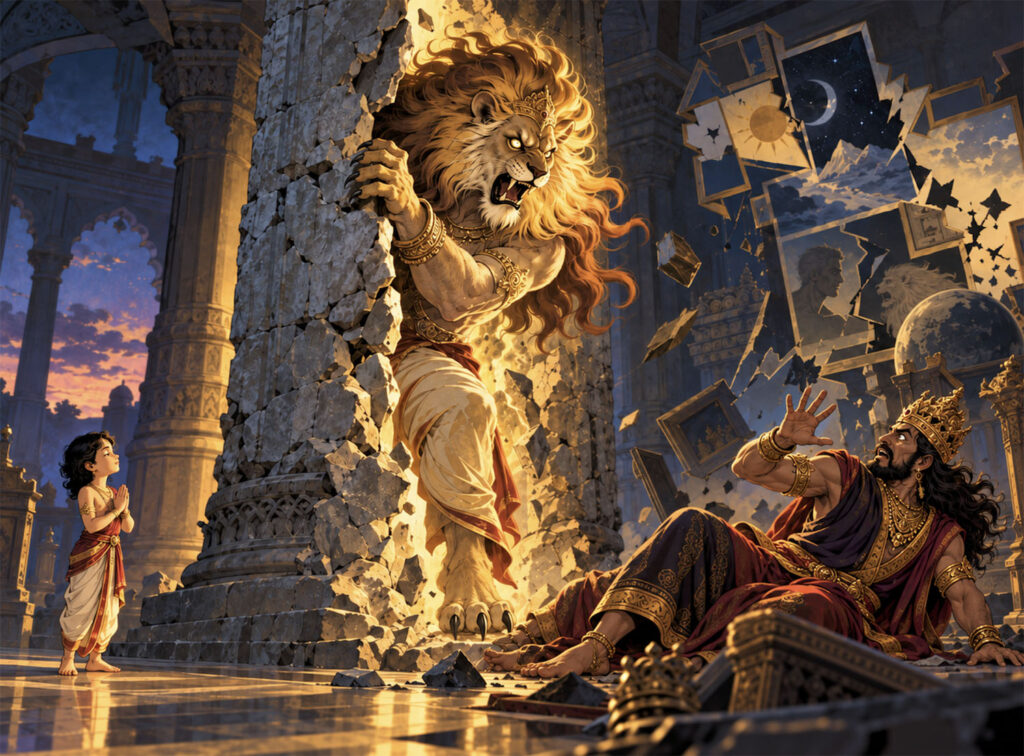
The king who had believed himself beyond the reach of death now found himself in the grip of a being for whom his elaborate safeguards counted for nothing.
It was twilight, neither day nor night. Narasimha dragged Hiranya to the threshold, neither indoors nor outdoors. He placed him upon His lap, neither earth nor sky. And tore him apart with His bare claws.
Neither man nor beast. Neither this nor that. Not one of Hiranya’s carefully contrived binaries had saved him.
But Narasimha‘s wrath was not yet spent. His terrifying form struck fear even among the gods, none of whom dared approach Him. And then, from among the trembling assembly, came little Prahlada.
The child fell at His feet.
Before the devotion of this little boy, the ferocity that had shaken the heavens melted into tenderness. Narasimha raised His hand and placed it upon Prahlada’s head in blessing.
Such is the grace of Bhakti. The Divine, before whom even the gods tremble, yields to the love of a child.
Hiranya had sought to imprison the entirety of existence within a set of mutually exclusive binaries, persuading himself that he had thereby tamed reality.
But reality was under no obligation to respect his taxonomy. Narasimha had emerged from the interstices of the very categories Hiranya believed exhausted all possibility. That is transcendence.
Hiranya had demanded to know whether Vishnu could possibly be present in the pillar, an inert object. The answer was as terrible as it was unequivocal.
There is no place where He is not. That is immanence.
The Narasimha episode is a philosophical statement in narrative form:
If you deny immanence, you miss the Divine in the world.
If you deny transcendence, you reduce the Divine to the world.
Hiranyakashipu denied the first – and was destroyed by the second.