The deeper questions.
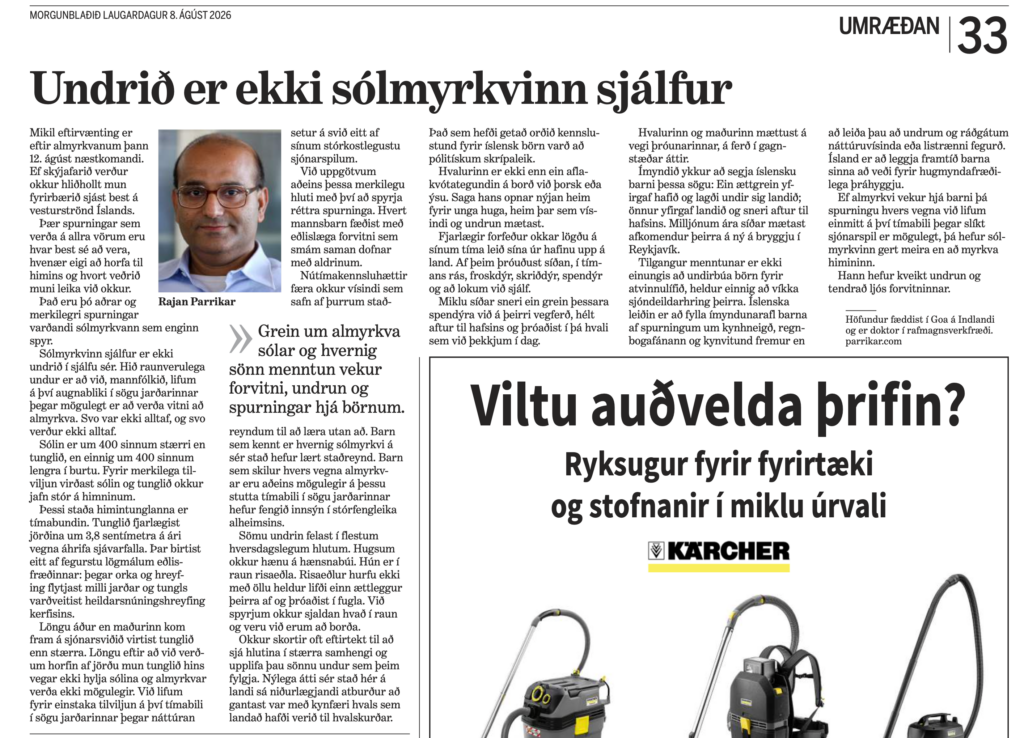
[This essay was published in Icelandic in Morgunblaðið on August 08, 2026. See screenshot below.]
The total solar eclipse on August 12, 2026 has generated great excitement. If the clouds cooperate, it will be best viewed from the western reaches of Iceland. Everyone will be absorbed with questions such as where to stand, what time to look, and what the weather will be.
But there is a far more profound question that almost nobody will ask.
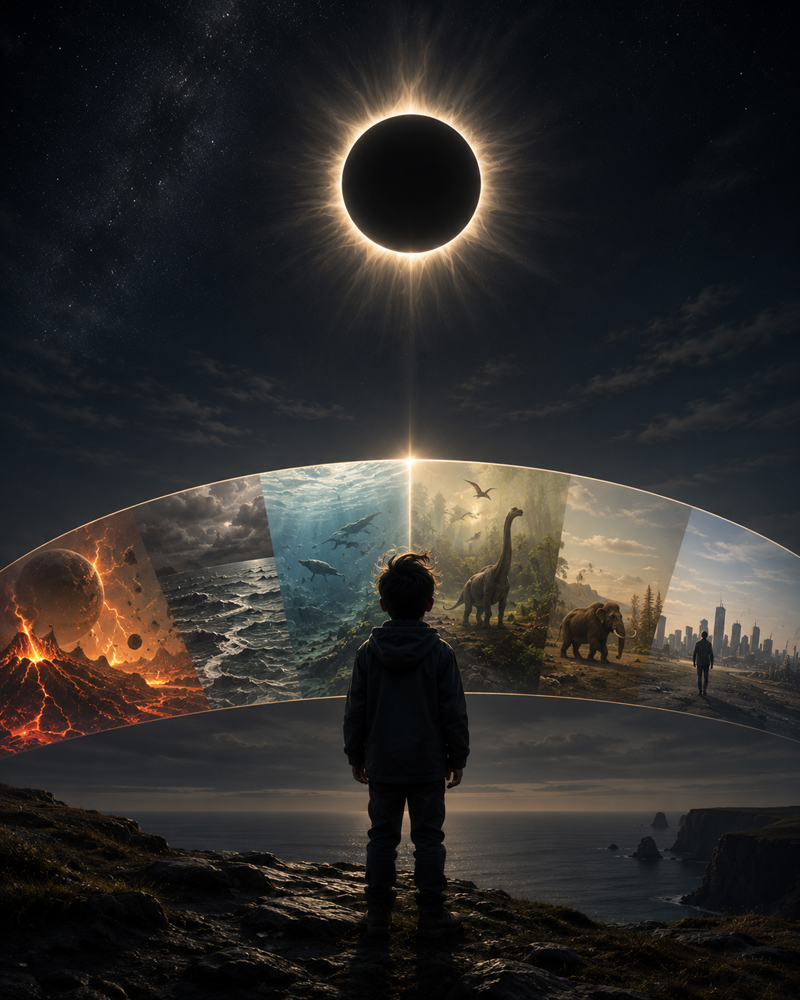
The eclipse itself is not the wonder. The wonder is that we happen to live at a moment in Earth’s history when total solar eclipses are even possible. It was not always so, and it will not always be so. (See Appendix.)
The Sun is about 400 times larger than the Moon, but also about 400 times farther away. By a remarkable coincidence, they appear almost exactly the same size in our sky.
This celestial arrangement is temporary. The Moon is receding from Earth by about 3.8 centimetres every year because of tidal interactions – one of the most elegant manifestations in physics of the conservation of angular momentum.
Long before humans existed, the Moon loomed larger. Long after we are gone, it will be too small to cover the Sun. We happen to live during the brief interval in Earth’s history when nature stages one of its greatest spectacles.
Such wonders surround us if only we ask the right questions. Every child enters the world with an instinctive curiosity only to lose it by the time adulthood arrives.
Modern education presents science as a collection of dry facts to be memorised. A child who learns only how an eclipse occurs has learned a fact. A child who learns why total eclipses are possible only during a fleeting epoch of Earth’s history has glimpsed the grandeur of the cosmos.
The same wonder lies hidden in the most familiar things. Consider the chicken. It is a dinosaur pecking at grain on the farm. Birds are not merely descended from dinosaurs; they are dinosaurs. The dinosaurs never disappeared. We rarely stop to think what it is we are eating.
Nature offers opportunities more often than we realise, but we reduce them to spectacles. Recently in Iceland there was the regrettable episode of a slaughtered whale brought into the harbour and its genitalia mocked for the media cameras. What could have become a teachable moment for Iceland’s children instead descended into a contest for political point-scoring.
The whale is not another fisheries quota alongside cod or haddock. Its story opens a new universe for the young mind, one that unites science with poetry. Our own distant ancestors once made the journey from water to land, giving rise in time to amphibians, reptiles, mammals and ourselves. Much later, one branch of those mammals reversed that journey, returning to the oceans and becoming the whales we know today. The whale and the human crossed paths on evolution’s highway, travelling in opposite directions.
Imagine telling this to an Icelandic child: one lineage left the sea and claimed the land; another abandoned the land and returned to the sea. Millions of years later their descendants meet again on a dock in Reykjavík
The purpose of education is not merely to prepare children for employment but to enlarge the horizon of their minds. Iceland chooses to occupy a child’s imagination with questions of sexuality, the rainbow flag, and gender identity rather than expose it to the mysteries of nature, the beauty of art, and the adventure of ideas. Iceland is squandering its seed corn at the altar of ideological fixations.
If a solar eclipse leaves a child wondering why we happen to live in the one epoch when such a spectacle is possible, then the eclipse has done more than darken the sky. It has illuminated a mind.
Appendix
The following passage bears elaboration:
“The wonder is that we happen to live at a moment in Earth’s history when total solar eclipses are even possible. It was not always so, and it will not always be so.”
Taken literally over the entire history of the Earth, the statement is true. During the Earth’s earliest history there was no Moon, and therefore no solar eclipses of any kind were possible. Hundreds of millions of years from now, the Moon will have receded sufficiently that total solar eclipses will again become impossible.
There is, however, a deeper point. Total eclipses also occurred when the Moon was much closer to the Earth, but their character was different. The Moon would have appeared substantially larger than the Sun, producing longer periods of totality while obscuring much of the inner solar corona.
Remarkably, throughout the entire history of the human species, the Moon has appeared almost exactly as it does today. Every human being who has ever stood beneath a total solar eclipse has witnessed essentially the same celestial geometry.
What distinguishes our epoch is the near equality of the apparent sizes of the Sun and Moon. It is this extraordinary coincidence that allows the luminous corona to emerge around a Moon that only just conceals the Sun.